

Virongy는 혁신적인 바이러스 연구 및 진단 기술을 개발하는 미국의 바이오기업으로,
바이러스 감염 연구와 치료법 개발을 위한 선도적인 솔루션을 제공합니다.
제품 설명
Rapid Alpha-Pseudoviruses for Orthohantavirus
제품 번호
option 선택
제품 특징
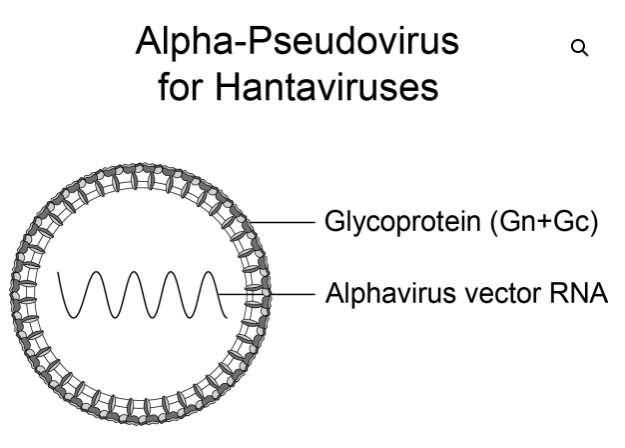
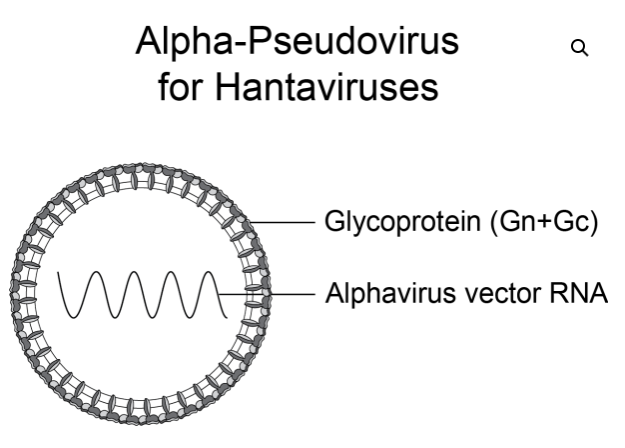
The rapid alpha-pseudoviruses for viruses belonging to the Orthohantavirus are assembled with the glycoproteins Gn and Gc and package a self-amplifying RNA genome derived from an alphavirus vector. The Andes virus (ANDV) alpha-pseudovirus is based on the NCBI reference sequence NP_604472.1.
A novel rapid hybrid alpha-pseudovirus for Orthohantavirus, including Andes virus (Ha-ANDV).
The alpha-pseudoviruses are single-cycle viruses with self-replicating RNA for rapid quantification of neutralizing antibodies and entry-inhibiting drugs. These pseudoviruses are BSL-2 safe and ready to use for studying viral entry. Additionally, we help our customers to assemble our hybrid alpha-pseudoviruses at any scale.
To enhance your pseudovirus entry, ask about receiving a free sample of our propriety InfectinTM which can significantly promote productive viral infection in a variety of host cells, enhancing viral infection rates by 3 to 20-fold.
Orthohantaviruses constitute one of the largest groups of RNA viruses, causing a spectrum of febrile and hemorrhagic illnesses worldwide. These viruses, predominantly tri-segmented and single-stranded, are transmitted primarily by arthropod and rodent vectors, infecting various animals and plants. Despite a small number of encoded proteins, Orthohantaviruses can lead to potentially fatal diseases, adept at suppressing the host’s innate antiviral immune mechanisms. Structurally, Orthohantaviruses consist of tri-segmented negative/ambisense RNA, with the Large (L), Medium (M), and Small (S) segments forming ribonucleoprotein structures complexed to nucleoproteins. These segments encode proteins crucial for viral replication and assembly, including the RNA-dependent RNA polymerase (RdRp) and glycoproteins Gn and Gc. Additionally, bunyaviruses may encode non-structural proteins (NSm and NSs), implicated in inhibiting the host immune response. Orthohantaviruses enter the host cell via receptor-mediated endocytosis through the surface glycoprotein Gc, which is responsible for binding to the cellular receptors. Upon attachment, Gc responds to the reduced pH of endocytic compartments with a conformational change that results in a fusion loop, allowing it to insert into the endosomal membrane. Gc then folds back on itself, forcing the cell membrane (held by the fusion loop) and the viral membrane (held by a trans-membrane anchor) against each other, resulting in fusion and releasing the viral genome into the cytoplasm. Some of the receptors facilitating the viral entry that have been described include clathrin-dependent endocytosis, 3 integrins, nucleolin, and DC-SIGN (a C-type lectin restricted to interstitial dendric cells and certain tissue macrophages). Understanding bunyavirus structure, genomics, and immune response evasion is essential for developing effective control measures against these diverse and potentially deadly pathogens.
Andes virus (ANDV) is a deadly viruses belonging to the hantavirus family within the Bunyaviridae order. ANDV stands out among hantaviruses as a significant cause of hantavirus pulmonary syndrome (HPS) cases in Argentina, Chile, and Uruguay. While rodents are recognized as the primary reservoirs for hantaviruses, ANDV presents an additional route of transmission through person-to-person spread, a feature unique among hantaviruses. This transmission mode was first documented during an HPS outbreak in southwest Argentina in 1996, highlighting ANDV’s exceptional characteristics. ANDV encompasses six distinct lineages, each associated with specific regions in Argentina. While clusters of HPS cases are typically linked to rodent exposure, our analysis reveals new evidence of interhuman transmission, particularly with ANDV Sout lineage. Additionally, we report the first instance of another lineage, ANDV Cent BsAs, being implicated in person-to-person transmission. This transmission likely occurs during the prodromal phase or shortly after, facilitated by close and prolonged contact. Understanding these transmission dynamics is crucial for effective control and prevention strategies against this deadly virus.
If you have any additional questions please contact us by email: info@virongy.com
Example of results:
Rapid ANDV alpha-pseudovirus luciferase transduction of Vero cells (Left): Vero cells were transduced with Ha-ANDV(Luc) alpha-pseudovirus (with a luciferase reporter). Reporter expression was quantified at 24 hours post-transduction (luciferase assay).
Rapid ANDV alpha-pseudovirus GFP transduction of Vero cells (Right): Vero cells were transduced with Ha-ANDV (GFP) alpha-pseudovirus (with a GFP reporter). Reporter expression was quantified at 24 hours post-transduction (GFP flow cytometry).

Ha-ANDV pseudoviruses are intended for Research Use Only and are not for diagnostic or therapeutic purposes or use in humans or animals.
Virongy Biosciences의 모든 제품을 만나 보세요!
Products
Services
Viral Neutralization Assay Services
Virongy Biosciences - Exclusive Distributor in South Korea "Morebio" 한국 독점 대리점 "모아바이오"


 MSDS
MSDS 온라인 견적


