

abinScience는 ProteoGenix의 핵심 연구 시약 브랜드로, 바이러스, 슈퍼박테리아, 기생충 등 신흥 병원체 연구를 위한 고품질 도구를 제공합니다.
제품 설명
Human FAP Recombinant Protein (C-His)
제품 번호
HC440011
제품 특징
| Catalog No. | HC440011 |
|---|---|
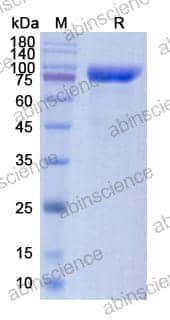
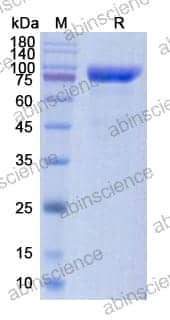
| Description | Recombinant Human FAP Protein, C-His (HC440011) expressed in Mammalian Cells, spanning Leu26-Asp760. Purity: >90% by SDS-PAGE. Highlights
|
| Expression system | Mammalian cells |
| Accession | Q12884 |
| Protein length | Leu26-Asp760 |
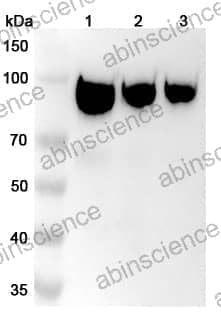
| Applications | ELISA, Immunogen, SDS-PAGE, WB, Bioactivity testing in progress |
| Species | Homo sapiens (Human) |
| Nature | Recombinant |
| Endotoxin level | Please contact with the lab for this information. |
| Purity | >90% as determined by SDS-PAGE. |
| Predicted molecular weight | 88.22 kDa |
| Form | Lyophilized |
| Storage buffer | Lyophilized from a solution in PBS pH 7.4, 1 mM EDTA, 4% Trehalose, 1% Mannitol. Please refer to the specific buffer information in the hardcopy of datasheet or the lot-specific COA. |
| Reconstitution | Reconstitute in sterile water for a stock solution. Adjust the volume of sterile water so that, after reconstitution, the final stock concentration matches the value indicated on the product label or datasheet. RECONSTITUTION PROTOCOL 1. Allow the product to be reconstituted and the reconstitution diluent to reach room temperature. 2. Tap or briefly centrifuge the product vial before opening to dislodge any lyophilized material that may be dispersed on the wall or cap of the vial. 3. Use the diluent and stock concentration recommended in the product datasheet. If preparing a stock concentration higher than recommended, contact Technical Service. 4. After adding the diluent, re-cap the vial and invert gently by hand or place on a slow rocking platform to allow the reconstitution diluent to coat all the surfaces inside the vial. Note: Do not mix by vortexing or by pipetting the material up and down. 5. Allow the vial to sit at room temperature with gentle agitation for at least 15 minutes before aliquotting or using. 6. Store the reconstituted material in single use aliquots in polypropylene or siliconized tubes. Aliquots of 10 μL or larger are recommended. |
| Shipping | In general, proteins are provided as lyophilized powder/frozen liquid. They are shipped out with dry ice/blue ice unless customers require otherwise. |
| Stability and Storage | Use a manual defrost freezer and avoid repeated freeze thaw cycles. Store at 2 to 8°C for frequent use. Store at -20 to -80°C for twelve months from the date of receipt. |
| Alternate Names | Surface-expressed protease, Gelatine degradation protease FAP, Integral membrane serine protease, Dipeptidyl peptidase FAP, Seprase, FAP, Post-proline cleaving enzyme, APCE, SIMP, FAPalpha, 170 kDa melanoma membrane-bound gelatinase, Fibroblast activation protein alpha, Serine integral membrane protease, Prolyl endopeptidase FAP |
| Background | Prolyl endopeptidase FAP (FAPalpha) is a ~87 kDa protein. Cell surface glycoprotein serine protease that participates in extracellular matrix degradation and involved in many cellular processes including tissue remodeling, fibrosis, wound healing, inflammation and tumor growth. Both plasma membrane and soluble forms exhibit post-proline cleaving endopeptidase activity, with a marked preference for Ala/Ser-Gly-Pro-Ser/Asn/Ala consensus sequences, on substrate such as alpha-2-antiplasmin SERPINF2 and SPRY2. Degrade also gelatin, heat-denatured type I collagen, but not native collagen type I and IV, vitronectin, tenascin, laminin, fibronectin, fibrin or casein. Also has dipeptidyl peptidase activity, exhibiting the ability to hydrolyze the prolyl bond two residues from the N-terminus of synthetic dipeptide substrates provided that the penultimate residue is proline, with a preference for Ala-Pro, Ile-Pro, Gly-Pro, Arg-Pro and Pro-Pro. Natural neuropeptide hormones for dipeptidyl peptidase are the neuropeptide Y (NPY), peptide YY (PYY), substance P (TAC1) and brain natriuretic peptide 32 (NPPB). 1. Lee, KN. et al. (2004) Blood 103, 3783-8. PMID: 14751930 2. Lee, KN. et al. (2006) Blood 107, 1397-404. PMID: 16223769 3. Edosada, CY. et al. (2006) The Journal of biological chemistry 281, 7437-44. PMID: 16410248 4. Edosada, CY. et al. (2006) FEBS letters 580, 1581-6. PMID: 16480718 5. Meadows, SA. et al. (2007) Biochemistry 46, 4598-605. PMID: 17381073 6. Aggarwal, S. et al. (2008) Biochemistry 47, 1076-86. PMID: 18095711 7. Huang, CH. et al. (2011) Journal of biochemistry 149, 685-92. PMID: 21288888 8. Keane, FM. et al. (2013) FEBS open bio 4, 43-54. PMID: 24371721 9. Levy, MT. et al. (1999) Hepatology (Baltimore, Md.) 29, 1768-78. PMID: 10347120 10. Mueller, SC. et al. (1999) The Journal of biological chemistry 274, 24947-52. PMID: 10455171 |
| Note | For research use only. |
abinScience의 모든 제품을 만나 보세요!
Recombinant Protein
Antibodies
Antibodies against Small Molecules
Assay Kits
abinScience - Exclusive Distributor in South Korea "Morebio" 한국 독점 대리점 "모아바이오"


 MSDS
MSDS 온라인 견적


