

다양한 분야에서 혁신적인 솔루션을 지원합니다.
The swine industry faces persistent challenges from highly contagious viral diseases that threaten animal health, food security, and global trade. Among these, African swine fever virus (ASFV), porcine epidemic diarrhea virus (PEDV), and porcine reproductive and respiratory syndrome virus (PRRSV) remain the most devastating pathogens, responsible for substantial economic losses worldwide. Rapid and reliable detection tools are therefore indispensable for effective surveillance and early containment. In recent years, single-domain antibodies (sdAbs), also known as VHH, have attracted much attention in disease diagnosis. Based on their features, VHHs are becoming a more promising tool for the detection of various diseases in comparison to conventional antibodies.
Serological detection offering a practical and sensitive means to monitor infection status and immune dynamics at the herd level. Measurement of virus-specific antibodies provides valuable insights into both active and past infections, enabling researchers to assess exposure history, evaluate vaccine performance, and support regional surveillance programs.
The competitive ELISA (cELISA) has become one of the most reliable and reproducible formats. Its capacity to measure antibody levels based on competition between serum antibodies and reference binding molecules ensures high specificity and compatibility with large-scale screening. Unlike indirect ELISA, which depends on secondary antibody conjugates that may vary across species, competitive ELISA enables consistent cross-sample comparison and is particularly well suited for diverse field conditions. Detection systems targeting immunodominant antigens such as ASFV p30 and p54, PEDV spike, and PRRSV N or GP5 proteins provide robust serological indicators of infection or immune status.
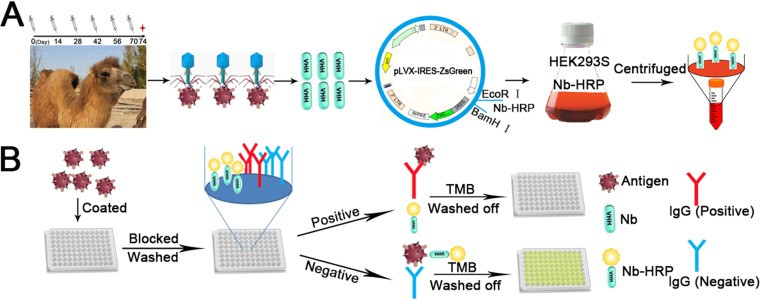
Fig. 1 Schematic representation of VHH screening, production and cELISA development.
Conventional polyclonal and monoclonal antibodies are widely used as indispensable reagents for kits development. Nevertheless, polyclonal antibodies suffer from batch-to-batch variability, while monoclonal antibodies have high costs and difficult genetic manipulation for production. VHH can be easily cloned and selected from immune or naïve VHH libraries due to their single-domain nature and strict monomeric behavior. In addition, they are easy to genetically manipulate and produce from a stored sequence. It can be fused with different reporters, which can be used as a probe to avoid the use of enzyme-labeled secondary antibodies and to develop one-step ELISA.
Creative Diagnostics offer a specialized range of recombinant viral antigens and VHH-based reagents (VHHs and VHH-HRP fusion proteins), for competitive ELISA development and related assay platforms. VHH-HRP probes can be directly applied in competitive ELISA without the need for secondary antibodies. Many of our VHH reagents are also well-suited for immunofluorescence assays, and some have demonstrated neutralizing activity, adding further value for research and assay development.
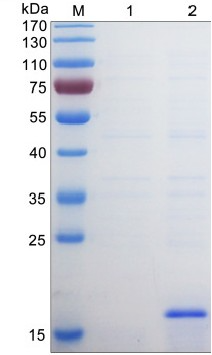 Fig. 2 Recombinant PRRSV-2 Nucleocapsid Protein.
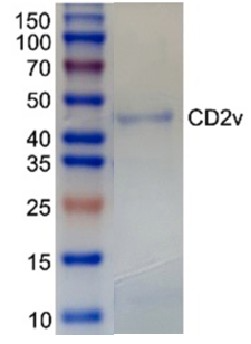 Fig. 3 Recombinant ASFV CD2v Protein.
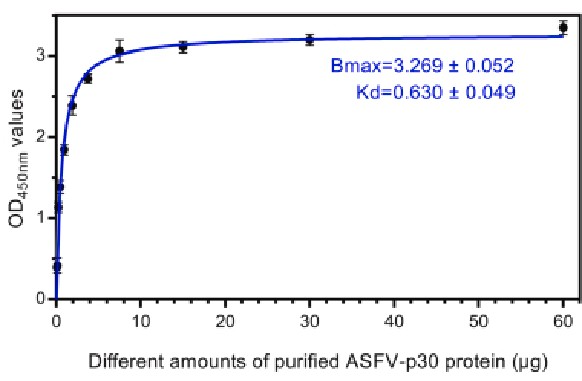 Fig. 4 Binding affinity analysis of anti-ASFV-p30 VHH-HRP to different amounts of ASFV-p30 proteins by ELISA.
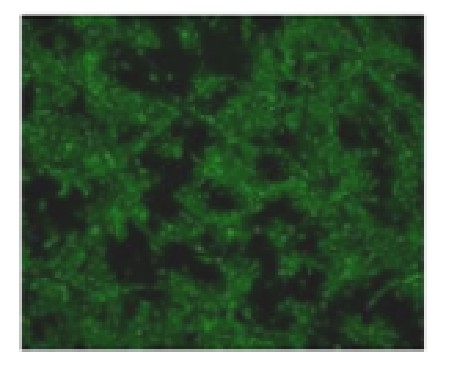 Fig. 5 IFA analysis of Vero cells infected with PEDV (HNXP) using anti-PEDV S VHH-HRP
References
CD Creative Diagnostics의 모든 제품을 만나보세요!
Products
Self-Assembled Monolayers Reagents
Protein-Based Fluorescent Nanoparticles
CD Creative Diagnostics - Official Distributor in South Korea "Morebio" 한국 공식 대리점 "모아바이오"


 MSDS
MSDS 온라인 견적


