본문 바로가기 주메뉴 바로가기

제품소개

제품상세페이지

Others

[MyBioSource] Amyloid Beta (APP) Antibody

Cat-No. MBS489032


Mybiosource는 생화학, 분자 생물학 및 면역학 분야에서 고품질의 연구용 제품을 제공하는 바이오기업으로,
다양한 항체, 단백질, 화학 물질 및 키트 등을 취급합니다.


제품 설명


Amyloid Beta (APP) Antibody


제품 번호


MBS489032


제품 특징


Product Name
Amyloid Beta (APP), Antibody
Full Product Name
Anti-Amyloid Beta [21F12]
Product Gene Name
Product Synonym Names
Abeta; A-beta; Abeta; Abeta42; Alzheimer disease amyloid protein; S-APP-beta
Isotype
Rabbit IgG kappa
Clone Number
21F12
Species Reactivity
Human
Form/Format
PBS with 0.02% Proclin 300.
Purity/Purification
Purified. Protein A affinity purified
Concentration
1mg/ml (lot specific)
Specificity
This antibody recognizes amino acids 33-42 of amyloid beta.
Preparation and Storage
Store at 4°C for up to 3 months. For longer storage, aliquot and store at -20°C.
Chromosome Location
Chromosome: 21; NC_000021.8 (27252861..27543446, complement). Location: 21q21.3
OMIM
104300
3D Structure
ModBase 3D Structure for P05067
Animal-free Manufacturing Platform
The recombinant antibody is manufactured using a recombinant, mammalian HEK293-based expression platform. The manufacturing platform is animal-free and animal component-free.

Product Categories/Family for anti-APP antibody

ISO Certification
Manufactured in an ISO 9001:2015 Certified Laboratory.
Applications Tested/Suitable for anti-APP antibody
Immunoprecipitation (IP), ELISA (EIA), Western Blot (WB), Immunohistochemistry (IHC)
Application Notes for anti-APP antibody
This antibody has very high specificity for Abeta1-42 over Abeta1-40. This antibody is capable of immunoprecipitating Abeta peptides ending at aa position 42 and also p3 peptides (PMID: 8917563). This antibody is also recomended for detection of amyloid beta using sandwich ELISA (PMID: 9037091, 19204155). This antibody was also used in the quantification of the proportion of full-length Abeta using western blotting (PMID: 12787077). This antibody has also been used for the identification of Abeta42 plaques on paraffin frontal sections(PMID: 15215183, 19660650). This antibody is unable to bind plaques in unfixed brain sections. This antibody is also not capable of clearing plaque after in vivo administration (PMID: 10932230).

Immunofluorescence (IF) of anti-APP antibody

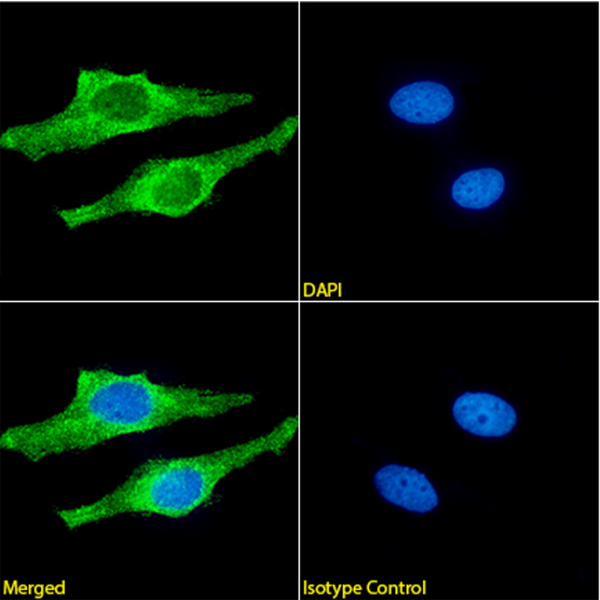
Immunofluorescence staining of HeLa cells with anti-Amyloid Beta 21F12 Immunofluorescence analysis of paraformaldehyde fixed HeLa cells stained with the chimeric rabbit IgG version of 21F12 (MBS489032) (1:1000 dilution) for 1h followed by Alexa Fluor 488 secondary antibody (1:1500 dilution), showing nuclear staining. The nuclear stain is DAPI (blue). Panels show from left-right, top-bottom MBS489032, DAPI, merged channels and an isotype control. The isotype control was anti-fluorescein antibody followed by staining with Alexa Fluor 488 secondary antibody.
Anti-APP Antibody – Cat# MBS489032

Related Product Information for anti-APP antibody

The original antibody was generated by immunizing A/J mice with a synthetic peptide (NH2-CYS-NH-CH2-(CH2)5-CO-GLMVGGVVIA-COOH) as an immunogen.
Describes the generation of different amino acid forms of amyloid beta by different protease activities.
This chimeric rabbit antibody was made using the variable domain sequences of the original Mouse IgG2b format, for improved compatibility with existing reagents, assays and techniques.

Product References and Citations for anti-APP antibody

Citron et al.
Proc Natl Acad Sci U S A. (1996); 93(23):13170-5.

Other Notes

Small volumes of anti-APP antibody vial(s) may occasionally become entrapped in the seal of the product vial during shipment and storage. If necessary, briefly centrifuge the vial on a tabletop centrifuge to dislodge any liquid in the container`s cap. Certain products may require to ship with dry ice and additional dry ice fee may apply.

Searchable Terms for APP purchase

MBS489032 is a Antibody targeting anti-APP antibody. Also known as Anti-Amyloid Beta [21F12]. Reactive in Human.

Additional Details

NCBI/Uniprot data below describe general gene information for APP. It may not necessarily be applicable to this product.

NCBI GI #
NCBI GeneID
NCBI Accession #
UniProt Primary Accession #
UniProt Secondary Accession #
UniProt Related Accession #
GenBank Nucleotide #
NCBI Official Full Name
amyloid beta A4 protein isoform a
NCBI Official Synonym Full Names
amyloid beta (A4) precursor protein
NCBI Official Symbol
APP
NCBI Official Synonym Symbols
AAA; AD1; PN2; ABPP; APPI; CVAP; ABETA; PN-II; CTFgamma
UniProt Protein Name
Amyloid beta A4 protein
UniProt Synonym Protein Names
ABPP; APPI; APP; Alzheimer disease amyloid protein; Cerebral vascular amyloid peptide; CVAP; PreA4; Protease nexin-II; PN-IICleaved into the following 14 chains:N-APPSoluble APP-alpha; S-APP-alphaSoluble APP-beta; S-APP-betaC99Beta-amyloid protein 42; Alternative name(s):; Beta-APP42Beta-amyloid protein 40; Alternative name(s):; Beta-APP40C83P3(42)P3(40)C80Gamma-secretase C-terminal fragment 59; Alternative name(s):; Amyloid intracellular domain 59; AICD-59; AID(59); Gamma-CTF(59)Gamma-secretase C-terminal fragment 57; Alternative name(s):; Amyloid intracellular domain 57; AICD-57; AID(57); Gamma-CTF(57)Gamma-secretase C-terminal fragment 50; Alternative name(s):; Amyloid intracellular domain 50; AICD-50; AID(50); Gamma-CTF(50)
UniProt Gene Name
APP
UniProt Synonym Gene Names
A4; AD1; APP; CVAP; PN-II; S-APP-alpha; S-APP-beta; AICD-59; AID(59); AICD-57; AID(57); AICD-50; AID(50)
UniProt Entry Name
A4_HUMAN
NCBI Protein Information
amyloid beta A4 protein; preA4; protease nexin-II; peptidase nexin-II; beta-amyloid peptide; alzheimer disease amyloid protein; cerebral vascular amyloid peptide

NCBI Summary for APP

This gene encodes a cell surface receptor and transmembrane precursor protein that is cleaved by secretases to form a number of peptides. Some of these peptides are secreted and can bind to the acetyltransferase complex APBB1/TIP60 to promote transcriptional activation, while others form the protein basis of the amyloid plaques found in the brains of patients with Alzheimer disease. Mutations in this gene have been implicated in autosomal dominant Alzheimer disease and cerebroarterial amyloidosis (cerebral amyloid angiopathy). Multiple transcript variants encoding several different isoforms have been found for this gene. [provided by RefSeq, Jul 2008]
Show more

UniProt Comments for APP

APP: a cell surface receptor that influences neurite growth, neuronal adhesion and axonogenesis. Cleaved by secretases to form a number of peptides, some of which bind to the acetyltransferase complex Fe65/TIP60 to promote transcriptional activation. The Abeta peptide is released from the cell, its extracellular deposition and accumulation form the main components of amyloid plaques in Alzheimer's disease. Mutations in this gene have been implicated in autosomal dominant Alzheimer disease and cerebroarterial amyloidosis. Can promote transcription activation through binding to Fe65-Tip60 and inhibits Notch signaling through interaction with Numb. Couples to apoptosis-inducing pathways such as those mediated by G(O) and JIP. Inhibits G(O) alpha ATPase activity. Acts as a kinesin I membrane receptor, mediating the axonal transport of beta-secretase and presenilin 1. Involved in copper homeostasis/oxidative stress through copper ion reduction. In vitro, copper-metallated APP induces neuronal death directly or is potentiated through Cu(2+)-mediated low-density lipoprotein oxidation. Can regulate neurite outgrowth through binding to components of the extracellular matrix such as heparin and collagen I and IV. Induces a RAGE-dependent pathway that activates p38 MAPK, resulting in internalization of amyloid-beta peptide and leading to mitochondrial dysfunction in cultured cortical neurons. Provides Cu(2+) ions for GPC1 which are required for release of nitric oxide (NO) and subsequent degradation of the heparan sulfate chains on GPC1. Binds, via its C-terminus, to the PID domain of several cytoplasmic proteins, including APBB family members, the APBA family, JIP1, SHC1 and, NUMB and DAB1. Binding to DAB1 inhibits its serine phosphorylation. Associates with microtubules in the presence of ATP and in a kinesin-dependent manner. Amyloid beta-42 binds nAChRA7 in hippocampal neurons. Beta-amyloid associates with HADH2. Soluble APP binds, via its N-terminal head, to FBLN1. Expressed in all fetal tissues examined with highest levels in brain, kidney, heart and spleen. Weak expression in liver. In adult brain, highest expression found in the frontal lobe of the cortex and in the anterior perisylvian cortex- opercular gyri. Moderate expression in the cerebellar cortex, the posterior perisylvian cortex-opercular gyri and the temporal associated cortex. Weak expression found in the striate, extra- striate and motor cortices. Expressed in cerebrospinal fluid, and plasma. 10 isoforms of the human protein are produced by alternative splicing. Isoform APP695 is the predominant form in neuronal tissue, isoform APP751 and isoform APP770 are widely expressed in non- neuronal cells. Isoform APP751 is the most abundant form in T-lymphocytes. Appican is expressed in astrocytes. The splice isoforms that contain the BPTI domain possess protease inhibitor activity. Belongs to the APP family.

Protein type: Cell surface; Receptor, misc.; Transcription factor; Membrane protein, integral; Apoptosis

Chromosomal Location of Human Ortholog: 21q21.3

Cellular Component: Golgi apparatus; extracellular space; cell surface; intracellular membrane-bound organelle; integral to plasma membrane; extracellular region; integral to membrane; dendritic spine; coated pit; intercellular junction; cytosol; ER to Golgi transport vesicle; lipid raft; ciliary rootlet; nuclear envelope lumen; perinuclear region of cytoplasm; axon; apical part of cell; cytoplasm; plasma membrane; synapse; spindle midzone; dendritic shaft; neuromuscular junction; endosome; receptor complex

Molecular Function: serine-type endopeptidase inhibitor activity; heparin binding; identical protein binding; protein binding; protease activator activity; enzyme binding; DNA binding; transition metal ion binding; PTB domain binding; acetylcholine receptor binding; receptor binding

Biological Process: extracellular matrix organization and biogenesis; adult locomotory behavior; locomotory behavior; mRNA polyadenylation; positive regulation of mitotic cell cycle; protein amino acid phosphorylation; regulation of translation; platelet degranulation; synaptic growth at neuromuscular junction; forebrain development; dendrite development; visual learning; collateral sprouting in the absence of injury; neuromuscular process controlling balance; cell adhesion; neurite development; cholesterol metabolic process; platelet activation; Notch signaling pathway; cellular copper ion homeostasis; regulation of epidermal growth factor receptor activity; axon cargo transport; mating behavior; regulation of multicellular organism growth; endocytosis; axon midline choice point recognition; smooth endoplasmic reticulum calcium ion homeostasis; neuron apoptosis; negative regulation of neuron differentiation; axonogenesis; suckling behavior; ionotropic glutamate receptor signaling pathway; regulation of synapse structure and activity; regulation of protein binding; innate immune response; positive regulation of transcription from RNA polymerase II promoter; response to oxidative stress; blood coagulation; neuron remodeling

Disease: Alzheimer Disease
Show more

Precautions

All of MyBioSource's Products are for scientific laboratory research purposes and are not for diagnostic, therapeutics, prophylactic or in vivo use. Through your purchase, you expressly represent and warrant to MyBioSource that you will properly test and use any Products purchased from MyBioSource in accordance with industry standards. MyBioSource and its authorized distributors reserve the right to refuse to process any order where we reasonably believe that the intended use will fall outside of our acceptable guidelines.

Disclaimer

While every efforts were made to ensure the accuracy of the information provided in this datasheet, MyBioSource will not be liable for any omissions or errors contained herein. MyBioSource reserves the right to make changes to this datasheet at any time without prior notice.

It is the responsibility of the customer to report product performance issues to MyBioSource within 30 days of receipt of the product. Please visit our Terms & Conditions page for more information.

Product Note

Select online data sheet information is drawn from bioinformatics databases, occasionally resulting in ambiguous or non-relevant product information. It is the responsibility of the customer to review, verify, and evaluate the information to make sure it matches their requirements before purchasing the kit. Our ELISA Kit assays are dynamic research tools and sometimes they may be updated and improved. If the format of this assay is important to you then please request the current manual or contact our technical support team with a presales inquiry before placing an order. We will confirm the current details of the assay. We cannot guarantee the sample manual posted online is the most current manual, it is intended to serve as an example only. Please refer to the instructions For Use provided with the assay kit for precise details.


Mybiosource에서 제공하는 모든 제품들을 만나보세요!


MyBiosource - Distributor in South Korea "Morebio" 한국 대리점 "모아바이오"